Metadata and artwork from TMDB. Not endorsed or certified by TMDB.
psychological
2025 · R · 2h 30m
Only monsters play God.
In the dark of the laboratory, the lightning struck. What rose from the table was not what Victor Frankenstein expected.
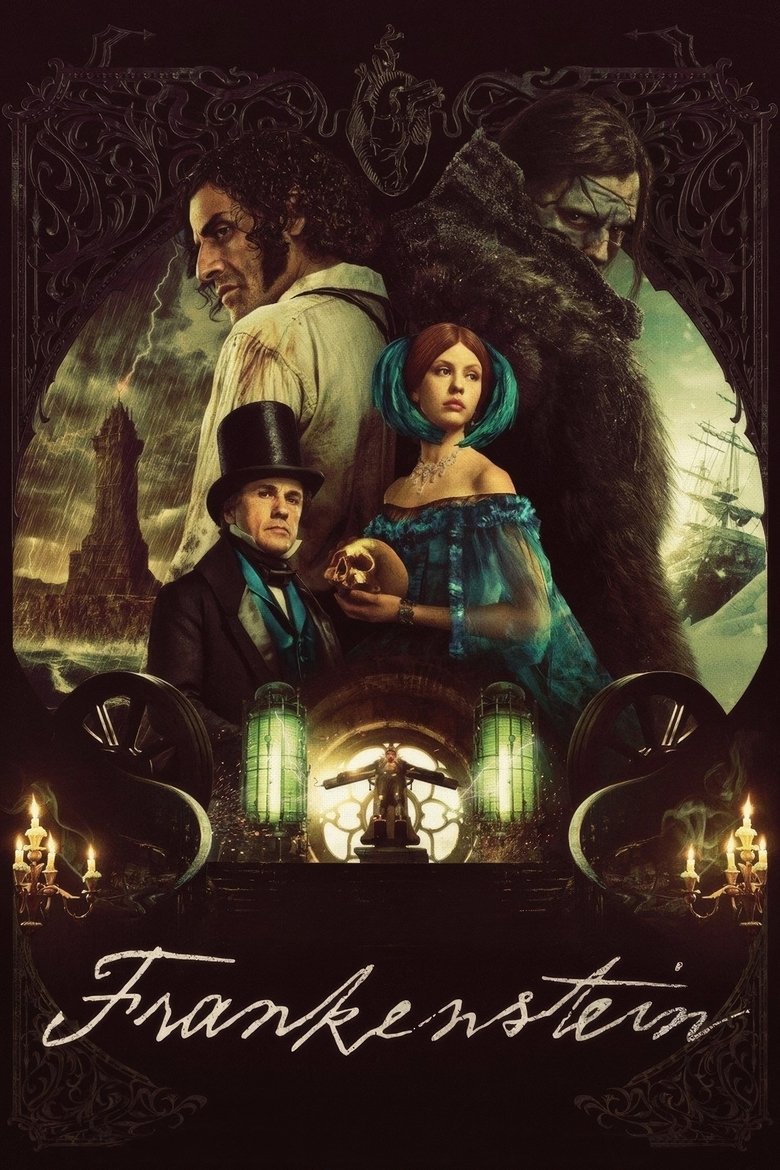
Frankenstein is Guillermo del Toro's long-gestating adaptation of Mary Shelley's foundational novel — a lavish, mournful epic that restores the creature's eloquence and humanity to the center of the story. Oscar Isaac plays Victor Frankenstein, driven mad by the obsession to cheat death; Jacob Elordi plays the creature he creates, a being of terrifying intelligence and devastating loneliness who demands to be understood. Del Toro's film is as much tragedy as horror: a story about the sin of creation without responsibility, and the wreckage left in its wake.
Tags
Based on 3 ratings
5.4
Overall
Victor Frankenstein grows up in 19th-century Geneva as the sensitive, intense elder son of an aristocratic family. His mother dies giving birth to his younger brother William, leaving Victor with a deep fixation on death and guilt over surviving when she did not. He becomes obsessed with the border between life and death, pursuing medicine and natural philosophy with single-minded zeal.
By 1855, Victor is a brilliant but arrogant surgeon conducting clandestine experiments on reanimating dead tissue. At a disciplinary hearing before the Royal College of Medicine, he presents his research — a body assembled from two deceased individuals — and claims he can restore life to it. The assembled doctors ridicule him. Only one man shows enthusiasm: Heinrich Harlander, a wealthy arms manufacturer who sees military applications in Victor's work. Harlander offers funding and protection in exchange for exclusive rights to whatever Victor creates. Victor accepts.
In Harlander's estate laboratory, Victor and his assistant animate a body assembled from corpses — tall and powerful, made from two principal donors. After a thunderous storm and a complex electrical-chemical procedure, the Creature opens its eyes and gasps in terror at its own existence. Victor, who fantasized about creating a perfect rational being, is horrified by the result's stitched flesh and raw confusion. He abandons his creation.
The Creature escapes, flees into the countryside, and experiences the world as an unwanted ghost — hiding in barns, glimpsing families from a distance, driven away with stones and screams wherever he is seen. He is intelligent and observant, learning language by secretly watching a household for weeks. A brief period of kindness from a blind man who cannot see his deformities gives him his only experience of being treated as a person. When the blind man's family returns and sees the Creature, they attack and burn the cottage. The incident crystallizes everything: humans will not accept him.
Back in Geneva, Victor's brother William is engaged to Elizabeth Harlander, Heinrich's virtuous niece. Victor manages the family estate while hiding his connection to the failed experiment. Harlander presses him for results, hinting at wider industrial and military uses. The Creature, having followed clues back to Geneva, eventually confronts Victor — speaking halting but clear language he has learned from observation. He tells Victor he was made without consent, abandoned, and has experienced only violence. He demands Victor create a companion so he will not be entirely alone. In exchange, he promises to disappear from human society forever. Victor stalls.
Harlander learns the Creature is alive and sees opportunity: a reanimatable body that feels no pain could make the perfect soldier. He orders Victor to capture the Creature and continue the experiments under closer supervision, threatening to implicate Victor and his family if he refuses. Meanwhile, the Creature witnesses Victor's domestic life — William's joy, Elizabeth's warmth — and understands how far he is from such acceptance. When William, frightened, lashes out and calls him names, the Creature kills him in an explosion of rage he cannot take back. Victor knows what happened but says nothing.
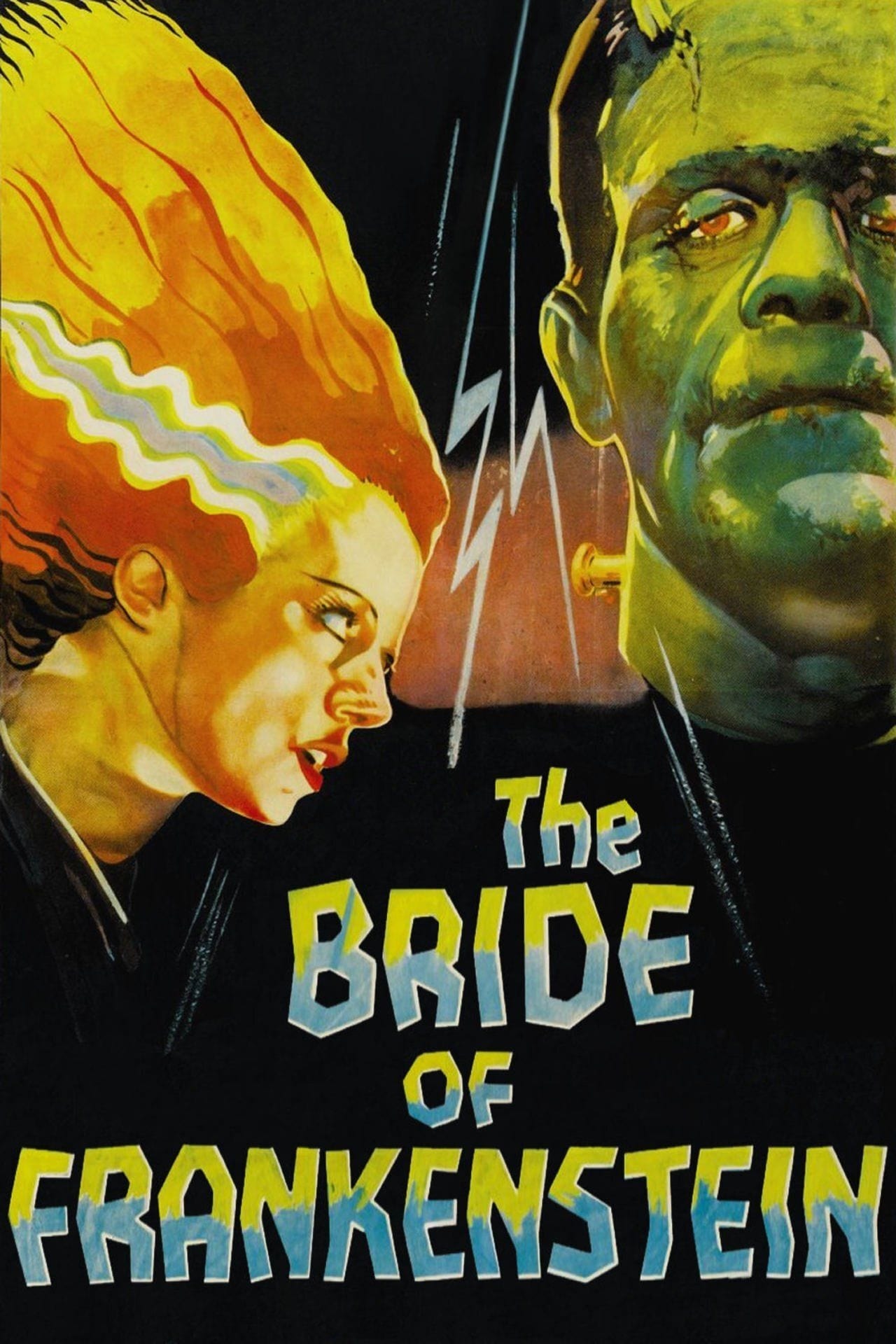
The Creature confronts Victor again, revealing he killed William to make Victor feel a fraction of his suffering. He reiterates his demand: create a female companion, or he will destroy everything Victor loves. Under this threat and Harlander's pressure, Victor begins work on a second creature — assembling a female body with greater care, trying to make her less visibly monstrous, blurring his grief and desire into the work. At the last moment, consumed by fear of what two such beings might become, he destroys the nearly completed Bride. The Creature, witnessing this final betrayal, vows revenge.
Victor and Elizabeth, brought together by grief for William, are pushed toward marriage by both families. On their wedding night the Creature infiltrates the estate and kills Elizabeth. Victor is left with nothing — his mother, his brother, the woman he loved, his scientific dream, his moral standing, all destroyed. Harlander's schemes spiral beyond his control. He either dies at the Creature's hands or is ruined as the violence exposes everything he built.
Victor, hollowed and obsessed, pursues the Creature across Europe and into the frozen Arctic, determined to destroy what he made even at the cost of his own life. A ship captained by Captain Anderson encounters Victor on the ice, ill and delirious. Victor recounts his story — the hubris, the creation, the chain of revenge. The crew glimpses the Creature moving across the ice. Victor attempts a final confrontation but his body fails. He dies of exhaustion and illness before he can reach the Creature.
The Creature finds Victor's corpse aboard the ship. In a quiet, devastating scene, he mourns the man who made and cursed him — expressing grief, hatred, and profound loneliness in equal measure. With Victor gone, there is no one left in the world who shares his origin or can understand him. Recognizing that his existence brings suffering to others and himself, the Creature walks into the Arctic wastes to let the cold erase him. The film ends with his figure receding into the blizzard — tiny and tragic against a vast, indifferent landscape — while Victor's story becomes a cautionary tale for Captain Anderson and, by extension, for us.
More Like This
Reviews
No reviews yet. Be the first.